

Florida Towing Laws and Road Safety: What Every Driver Needs to Know Before Hitting the Highway
Whether you are hauling a vessel down to the Keys for the weekend, towing heavy machinery across I-4 for a job site, or transporting commercial mowers through residential neighborhoods, towing a trailer in Florida comes with legal responsibilities.
Between sudden downpours, congested highway traffic, and strict state regulations, staying safe and compliant requires more than just dropping a hitch on a ball and driving off. Failing to adhere to Florida towing laws can lead to costly traffic fines, failed roadside inspections, or dangerous accidents on high-speed corridors like I-95, I-75, or the Florida Turnpike.
At AT Trailer Center, road safety and legal compliance are fundamental. To keep your rig legal and your transit safe, here is the complete guide to Florida trailer regulations, required safety equipment, and essential driving practices.
1. Florida Trailer Equipment and Brake Laws
Florida law strictly dictates what safety equipment your trailer must feature before hitting public roads. Depending on the size and weight of your load, missing these equipment requirements can result in immediate citations.
Brake Requirements (GVWR Thresholds)
Under Florida Statutes § 316.261, any trailer with a Gross Vehicle Weight Rating (GVWR) of 3,000 pounds or more must be equipped with brakes acting on all wheels. Furthermore, the braking system must include an emergency breakaway mechanism designed to automatically engage and stop the trailer if it ever disconnects from the tow vehicle while in motion.
If you are buying heavy hauling equipment and need to clarify weight ratings, review our guide on Equipment Trailers: When "Heavy Duty" Needs a Real Definition
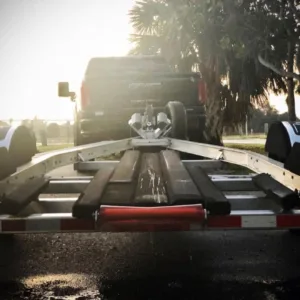
Safety Chains
Florida law mandates that all bumper-pull setups utilize dual safety chains or steel cables as an auxiliary connection.
-
Rating: Chains must be structurally rated to equal or exceed the combined gross weight of the loaded trailer.
-
Crossing Method: Always cross your safety chains in an "X" pattern beneath the trailer tongue. This setup forms a protective cradle to catch the tongue if the coupler detaches from the ball, preventing it from digging into the asphalt at high speeds.
Lighting and Visibility
To legally operate at night or during Florida's frequent thunderstorm downpours, your trailer must be equipped with operational lighting that complies with Federal Motor Vehicle Safety Standard No. 108:
-
Red taillights and brake lights
-
Rear turn signals
-
Yellow/red clearance lights and side reflectors (mandatory for trailers 80 inches or wider)
-
A dedicated white license plate light that renders the registration tag legible from 50 feet away
If your electrical connections are corroded or your lights flicker, stop by our shop or read our comprehensive guide on Your Complete Guide to Trailer Service, Repairs, and Custom Fabrication in Florida[cite: 3]. You can also stock up on replacement harnesses by checking out Essential Trailer Parts and How to Keep Them in Top Shape
2. Highway Speed Limits and Lane Restrictions
Handling a heavy load significantly changes your stopping distance, turning radius, and acceleration on busy Florida highways.
Speed Regulations
In Florida, speed limits for towing vehicles match posted passenger car limits unless a specific lower limit is displayed for commercial or multi-axle traffic. However, driving at the maximum posted limit (e.g., 70 mph) with a heavy haul is rarely advisable. High speeds compound trailer sway and exponentially increase stopping distances on wet asphalt.
Lane Restrictions
On highways or turnpikes featuring three or more lanes traveling in one direction, towing vehicles are legally restricted from driving in the far-left lane (reserved for high-speed passing). Drivers should remain in the right or center lanes to allow faster traffic to pass safely on the left.
3. Weight Distribution, Hitching, and Sway Control
Improper weight loading is the single leading cause of loss-of-control accidents involving light and commercial trailers.
The 60/40 Weight Distribution Rule
When securing cargo on utility trailers, car haulers, or enclosed units:
-
Place approximately 60% of the total load weight in the front half of the trailer deck (closest to the tow vehicle hitch).
-
Place the remaining 40% over and behind the axle assembly.
-
Center the load evenly from left to right.
Placing too much weight toward the rear creates a reverse leverage effect on the hitch, causing severe, uncontrollable trailer sway at highway speeds.
Choosing the Right Hitch Setup
Your tongue weight should equal roughly 10% to 15% of the total loaded trailer weight for standard ball hitches. If you are comparing different trailer configurations for commercial or marine use, explore our detailed comparisons:
-
To evaluate hitch stability for heavy commercial hauling, read Gooseneck vs. Bumper Pull Trailers Explained
-
For specialized hauling, check out our insights on Boat Trailers and Car Haulers in Florida
-
First-time trailer buyers can learn how hitch classes and ball sizes work in Best Trailer for First-Time Buyers: The Ultimate Beginner's Guide[cite: 1].
4. Title, Tag, and Registration Requirements
Operating legally on Florida roads requires proper documentation through the state:
-
Every trailer operated on public roads must be registered through the Florida Highway Safety and Motor Vehicles (FLHSMV).
-
Trailers with a net weight over 2,000 pounds must also hold an official Florida Certificate of Title.
-
Registration license plates must be securely mounted to the rear of the trailer and remain fully visible and illuminated.
For a step-by-step walkthrough of paperwork, sales tax calculations, and DMV registration processes, refer to our guide on Florida Trailer Registration Requirements: The Complete Step-by-Step Guide
5. Florida Driver Safety Best Practices
Beyond mechanical equipment and legal mandates, safe towing in Florida requires continuous defensive driving habits:
-
Maintain a 5-Second Following Distance: Heavy loads require significantly longer braking distances. In rain or high-humidity road conditions, increase following distance to 6 or 7 seconds.
-
Eliminate Blind Spots: Standard truck mirrors are often insufficient. Use extended towing mirrors to monitor adjacent lanes when hauling wide enclosed cargo units or wide-deck car haulers.
-
Conduct Pre-Trip Walkarounds: Perform a 5-minute pre-flight inspection before every single journey. Check tire inflation pressures (cold), verify light operation, ensure coupler pins are locked in place, and confirm safety chains are latched.
-
Avoid Critical Setup Oversights: Learn what to look for before leaving the lot by reviewing The Trailer Details Buyers Usually Notice Too Late
For additional driving technique advice, consult our dedicated safety manual on How to Safely Tow a Trailer: Tips from AT Trailer Center
Tow Safely with AT Trailer Center
Staying compliant with Florida towing regulations protects your equipment, safeguards your cargo, and keeps everyone sharing the road safe.
Whether you need a complete safety inspection, electric brake installation, custom wiring repairs, or expert advice on selecting the right setup for your business, the team at AT Trailer Center is here to help. Stop by our showroom or reach out to our service team today to make sure your trailer is 100% road-ready.